Should your water tank go on the roof or the ground?
9 cards · about 42 KB · Updated · From Tanks and Taps Jamaica
The answer
Water tank on roof or ground is mostly a weight decision: a full 1,000-gallon tank holds 3,785 to 4,546 kg of water alone, tank not counted, so choose the ground unless an engineer clears the roof.
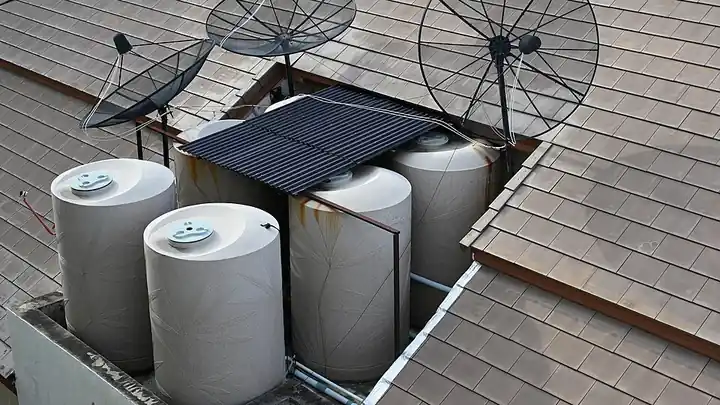
How heavy is a full tank?
Who handles this: You
Heavier than most people guess: a 650-gallon tank is over 2.4 tonnes and a 1,000-gallon tank can pass 4.5 tonnes. These are water alone, tank not counted, using our rule of thumb that 1 litre of water is about 1 kg. Your tank's own weight, the stand and the pipes come on top.
The figure depends on the gallon. Sellers do not always say which one they mean, so ask for the capacity in litres. Our tank size stack explains the difference.
- 650 gal US2,461 kg
- 650 gal imperial2,955 kg
- 1,000 gal US3,785 kg
- 1,000 gal imperial4,546 kg
Source: Our arithmetic from NIST, SP 811 conversion factors; the 1 L to 1 kg step is our own note, not from a Jamaican document.
Next: What does each position give and need?What does each position give and need?
Who handles this: You
Each swaps pressure for weight and access.
| Roof | Stand | Ground | |
|---|---|---|---|
| Taps in a power cut | Keep running | Keep running | Stop, unless a line bypasses the pump |
| Load problem | Roof structure | Stand and footing | Slab only |
| Pump | Often none | Often none | Needed |
| Cleaning and checks | Roof-level work | Paid person, dry calm day | Easiest |
A roof tank must also fill. On a weak supply, water may not climb that high, so a ground tank that fills slowly with a pump and pressure tank after it is the common way out. See low pressure for testing yours.
Source: General plumbing practice, not a Jamaican document.
Next: Can my roof take a tank?Can my roof take a tank?
Who handles this: Qualified engineer
Only an engineer who has seen the structure can tell you, so get that answer before anything is lifted. We found no Jamaican rule setting a roof load for a house tank.
For scale, one maker's manual (Rheem, New Zealand) puts a 180-litre solar heater with one collector at 331 kg on the roof, and says "If in doubt, consult a structural engineer". A US 650-gallon tank's water is more than seven times that, our sum.
Count everything on the same roof. If a solar water heater is there or planned, tell the engineer. The Kingston and St Andrew corporation lists "Additions /alterations and external repairs" as needing permission, so ask it whether a new roof tank counts: see building approval.
Source: Rheem NZ, Installation instructions, undated; KSAMC, Application forms and guidelines, read 2 Nov 2026
Next: How high does a tank need to be for good flow?How high does a tank need to be for good flow?
Who handles this: Plumber
One maker's installation manual (Rotoplas, Central America, in Spanish, 2013) asks for at least 2 metres from the tank outlet to the highest outlet in the house. We could not confirm that this brand is sold in Jamaica, and we found no Jamaican figure, so read it as a guide.
Height is what makes gravity supply work. Measure from the tank's outlet, not its lid, up to your highest shower or tap. A single-storey roof tank can fall short for a shower head that needs some push, including an electric shower head, and a plumber can tell you whether yours will.
Source: Rotoplas Central America, Manual de instalacion, 2013
Next: What does a tank on the ground need?What does a tank on the ground need?
Who handles this: Plumber
A level, smooth slab and a pump. The Rotoplas manual asks for "una base plana y lisa", a flat, smooth base, with at least 5 cm of slab showing around the tank. Stones or a rough patch under the tank press into a plastic wall, and the full weight above sits on them.
The trade-off is electricity. Without a pump there is no useful pressure, and in a power cut the taps stop unless a plumber has given you a gravity line for a low tap. Keep the pump dry, off the ground and out of the path of yard floodwater.
Source: Rotoplas Central America, Manual de instalacion, 2013; General plumbing practice, not a Jamaican document.
Next: Is a steel or concrete stand a good middle way?Is a steel or concrete stand a good middle way?
Who handles this: Qualified contractor
It can be, if it is designed for the full weight and not just knocked together. A stand has to carry the same 2,461 to 4,546 kg of water as a roof, high up, on a small footprint, in hurricane wind.
Ask whoever builds it what footing it stands on, how it is braced, and how the tank is held down. Salt air is hard on bare steel near the coast: our salt air stack covers that. The top platform should be bigger than the tank base, so the tank never overhangs it. Get the design written down and keep it with your papers.
Source: General plumbing practice, not a Jamaican document.
Next: Who should do roof-level tank work?Who should do roof-level tank work?
Who handles this: Trained, paid person
Someone trained and paid to do it, on a dry, calm day. Rain, wind or a storm warning all mean nobody goes on the roof. A wet zinc roof gives no grip at all.
Do what you can from the ground: look at the overflow, the lid and any drips with a phone camera or from a window. Float valves, lids and leaks at roof level are work for the person you hire. Our hiring stack explains what to ask, and why we could not confirm any plumber's licence or register here.
Source: General plumbing practice, not a Jamaican document.
Next: How is a tank secured for hurricane season?How is a tank secured for hurricane season?
Who handles this: Qualified contractor
Book a qualified person to fix the ties well before the season opens. The Office of Disaster Preparedness and Emergency Management (ODPEM) gives the season as June 1 to November 30. Nothing we found from ODPEM deals with tying down water tanks, or says whether one rides out wind better full or empty, so ask the installer.
ODPEM's own tips stop at galvanised sheeting being "securely fastened" and small yard buildings latched down. Hurricane Melissa came ashore on 28 Oct 2025 with sustained winds of 185 mph, the Office of the Prime Minister reported. No tank should be tied down once a warning is out: by then, stay off the roof. See before the hurricane.
Source: JIS, ODPEM hurricane tips, undated; OPM, Statement to Parliament, 6 Nov 2025