What salt air does to plumbing near the sea
10 cards · about 99 KB · Updated · From Tanks and Taps Jamaica
The answer
Salt air corrosion strips zinc and rusts steel fastest on the seafront, so near the coast favour plastic pipe or grade 316 stainless where allowed, and check whatever stays exposed.

Is there Jamaican guidance on salt corrosion?
Who handles this: You
None that we could find. We looked for a Caribbean or University of the West Indies source on how fast pipes and fittings corrode here and found nothing usable.
So the corrosion figures on this stack come from British and Australian trade bodies, one of them working from an international standard. Use it as a guide to which way the risk runs, not as a forecast for your street.
Jamaica's sea, wind and heat are not those of Sydney or Hull. Your own best evidence may be the state of a neighbour's outdoor taps, tank bolts and pump after a few years in the same spot.
Source: SteelConstruction.info, Corrosion of structural steel; ASSDA, Technical FAQ 6
Next: How fast does bare steel rust by the sea?How fast does bare steel rust by the sea?
Who handles this: You
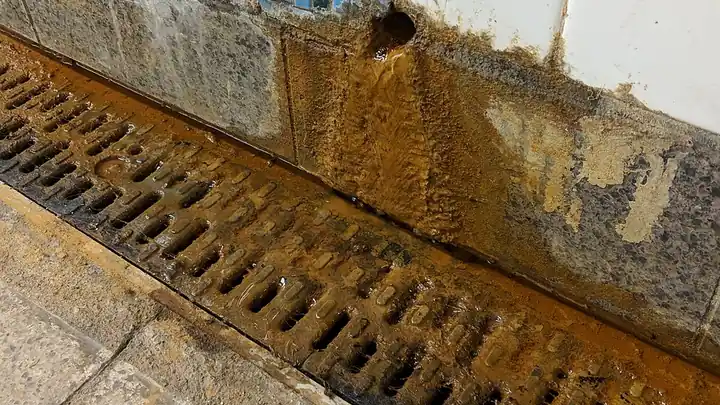
Fast, and the rate climbs steeply with salinity. These are first-year losses for carbon steel from SteelConstruction.info, a UK source, which says its classes are identical to those in BS EN ISO 9223.
| Class | Setting it describes | Loss, micrometres |
|---|---|---|
| C3 | Coast, low salinity | Over 25 to 50 |
| C4 | Moderate salinity | Over 50 to 80 |
| C5 | High salinity | Over 80 to 200 |
| CX | Includes sub-tropical and tropical atmospheres | Over 200 to 700 |
We have no reading that places any Jamaican address in a class. The practical lesson is plain enough: unprotected steel has no place outdoors on the coast.
Source: SteelConstruction.info, Corrosion of structural steel
Next: How long will galvanised pipe last near the beach?How long will galvanised pipe last near the beach?
Who handles this: Plumber
Less long than inland, because the zinc coat is what gets used up. Australia's INGAL manual says severe ocean-front sites "may have zinc corrosion rates of around 20 microns or more per year".
To estimate, take the coating thickness from the supplier's data and divide by 20. That is our sum, and a rough one. Once the zinc has gone, the steel underneath starts to rust at the rates shown above.
Old galvanised pipe also rusts from inside, whatever the air is doing, which can shrink the bore and show up as weak flow at the taps. A plumber can tell you whether it is worth replacing sections or the full run.
Source: INGAL, Predicting the life of galvanised coatings
Next: How far from the sea does this matter?How far from the sea does this matter?
Who handles this: You
Two Australian figures are worth knowing, and neither was measured here. INGAL's manual puts its C4 class "Within one kilometer of ocean surf". ASSDA, the Australian stainless steel body, says staining shows up "most commonly within about five kilometres of the surf".
Treat 1 km and 5 km as prompts to look, not as lines on a map. Onshore wind, breaking surf and open ground carry salt further; a hill or a row of buildings may shelter you.
If you live in Portmore or around Montego Bay, look at what is already outdoors on your property. The rust will tell you.
Source: INGAL manual; ASSDA, Technical FAQ 6
Next: Is grade 316 stainless worth the extra money?Is grade 316 stainless worth the extra money?
Who handles this: You, when buying
For anything exposed on the coast, yes. ASSDA's advice is to "use grade 316 or one with equivalent corrosion resistance" in marine settings. It says grade 304 "has occasionally been successfully used" but is not recommended.
"Stainless" on a label tells you little. Ask the supplier which grade, and get it on the receipt, for:
- Hose clamps on outdoor runs
- Bolts holding a tank stand or pump base
- Outdoor tap bodies and strainers
One trade body's advice, from Australia, but it fits what most coastal yards show: the cheap clamp goes first.
Source: ASSDA, Technical FAQ 6
Next: Why not just switch to plastic pipe?Why not just switch to plastic pipe?
Who handles this: Plumber
For your own pipes, often yes, since plastic does not rust. The catch is sun. Most plastic pipe weakens in direct sunlight unless it is shielded or rated for it, and PEX in particular belongs indoors or under cover.
The documents we read do not say which pipe materials are allowed in a house. If the change is part of an addition or alteration, it should show on the plumbing layout in your building application.
Everything from the meter towards the street stays with the National Water Commission (NWC): leave it alone, whatever it is made of. Metal fittings where plastic meets a tap or tank still need watching.
Source: General plumbing practice, not a Jamaican document.
Next: What should you check first around the house?A model to compare
PEX pipe for drinking water. A potable-rated pipe to compare for indoor and covered runs, where a coastal house has rusted out its old metal lines.
Plumbing Supply and More has the same owners as this site. It is a US business and shipping to Jamaica is not promised, so treat this as a model to compare, then ask your local supplier for the same type.
What should you check first around the house?
Who handles this: You, on the ground
Walk round from ground level, with a torch, and note anything flaking or stained:
- Outdoor taps and the stop valve at the house
- The pump body and its base bolts
- Tank stand brackets and straps
- Frames and fixings on a solar water heater, seen from the yard
- Small shut-offs under basins and toilets: turn each gently, since a seized one will not help in a leak
Electrical boxes and rusted pump connections are for a licensed electrician, breaker off first. Roof-level items wait for a paid person on a dry, calm day. Never go up yourself in wet weather or wind.
Source: General plumbing practice, not a Jamaican document.
Next: Does rinsing with fresh water help?A model to compare
Angle stop valves. Worth comparing by body material when the small shut-offs under your basins have gone stiff in coastal air.
Plumbing Supply and More has the same owners as this site. It is a US business and shipping to Jamaica is not promised, so treat this as a model to compare, then ask your local supplier for the same type.
Does rinsing with fresh water help?
Who handles this: You, on the ground
It should, since salt left sitting on metal keeps working, though we have no study putting a number on it. Wipe outdoor fittings with a damp cloth every so often, more often after a dry, windy spell, and dry anything that holds a puddle.
Use a bucket and rag. The Gleaner reported a 2026 hose ban in some parishes, and stored water during a lock-off has better uses.
Salt also attacks the fixings you depend on in a storm. ODPEM asks householders to see that roof sheeting is "securely fastened", so have rusty ones looked at before the hurricane season, by someone trained, and never in wind.
Source: ODPEM via JIS, Hurricane Safety Tips, undated; Gleaner, 2026 Prohibition Notices, 11 Aug 2026
Next: Could salty water be doing the damage, not the air?Could salty water be doing the damage, not the air?
Who handles this: You
Yes, if you are on a coastal well. Corrosion from inside looks different: pinholes and failed heaters rather than flaking on the outside. The Water Resources Authority treats chloride above 250 mg/L as a sign of saline intrusion, and names several south and north coast management units as vulnerable.
One maker's manual, Rheem New Zealand, says chloride above that same 250 mg/L voids the warranty on its stainless cylinder. That is one maker, not Jamaican data, but do read the terms before you buy a heater.
Testing a well or spring for chloride gives you a number to work with. We found no salinity figures by parish.
Source: WRA, Master Plan 2022, p.62; Rheem NZ, solar manual, 2014