Are electric shower heads safe, and what makes them dangerous?
9 cards · about 16 KB · Updated · From Tanks and Taps Jamaica
The answer
Electric shower head safety comes down to this: breaker off before touching anything, a certified electrician for all wiring, and no more use if it tingles, buzzes or shows scorch marks.
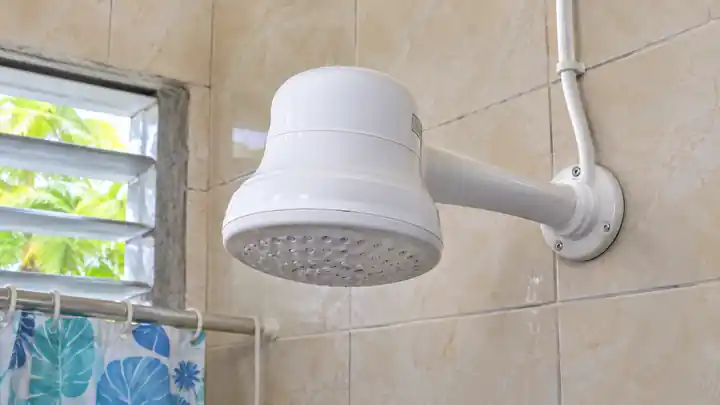
Is there a Jamaican rule for electric shower heads?
Who handles this: You
We looked and found none. No page we could reach from the Jamaica Public Service, the Government Electrical Regulator, the Bureau of Standards, the Fire Brigade or the Ministry deals with electric or instant showers by name. Some of those sites could not be fully read, so a rule may still exist.
The nearest item is JS 168, on the Bureau's 2012 compulsory list, which covers electric storage-tank water heaters. That is a different appliance, and the list may be out of date.
So this page rests on one maker's manual, general electrical practice and a Fire Brigade warning about old wiring.
Source: BSJ compulsory list copy (2012)
Next: What does a maker's manual ask for?What does a maker's manual ask for?
Who handles this: Electrician
One maker's manual, for the Midea DSF55EA1, gives firm figures. It covers an instant wall heater, not a head-mounted unit.
- "Plug is not used"
- "Dedicated circuit must be used"
- "Installing device without earthed is highly prohibited"
- 2.5mm2 wire, a "≥25A" switch, leakage protection at "15mA"
These are not Jamaican requirements, and your unit's manual governs your unit. They do show what a careful install looks like. Ask your electrician: is this on its own circuit, is it earthed, and is there leakage protection? Do not try to answer those by opening anything yourself.
Source: Midea, DSF55EA1 user manual
Next: Which warning signs mean stop using it today?Which warning signs mean stop using it today?
Who handles this: You
Any of these means no more showers from that head until it has been checked:
- A tingle from the water, the head or the pipe
- Brown or black scorch marks, or melted plastic
- A buzz, crackle or hot-plastic smell
- Water getting in or dripping around the cover or the wires
- The breaker tripping when the shower runs
If it happens mid-shower, get out first, dry off, then switch the breaker off from dry ground. Leave it off, and tell the household why. A tripping breaker is doing its job, so do not keep resetting it or swap it for a bigger one.
Source: General electrical practice, not a Jamaican document.
Next: What has to happen before anyone touches the head?What has to happen before anyone touches the head?
Who handles this: You
Breaker off, before touching anything, every time. A wall switch or pull cord beside the shower is not the same thing. If nobody knows which breaker feeds it, have an electrician label the panel.
Keep your hands and feet dry, and do not work from a wet floor. With the breaker off, the only owner job is rinsing the spray plate if the holes have furred up with scale, which can happen wherever water is hard.
Anything behind the cover is the electrician's. That means no opening the case, no tightening or taping wires, and no swapping the head for a new one on the old connection.
Source: General electrical practice, not a Jamaican document.
Next: Who should wire it, and what about an old house?Who should wire it, and what about an old house?
Who handles this: Electrician
A licensed, certified electrician, for all of it. The Fire Brigade's Commissioner, speaking about houses 30 to 40 years old, told people to "find a certified electrician", as JIS reported on 24 October 2026. A shower head can draw far more than old wiring was laid out to carry.
Grid connections involve "Government Electrical Regulator (GER) certification", according to JIS, June 2026. We could not read GER's own steps, so ask your electrician whether certification applies. On who to trust generally, see hiring a plumber.
Source: Fire Commissioner via JIS, October 2026; JIS on JSIF wiring, June 2026; the load point is general practice
Next: Why does it run scalding, then cold, or cut out?Why does it run scalding, then cold, or cut out?
Who handles this: Plumber
Usually because of the water flow. These heads heat water only as it passes, so a weak flow comes out very hot and a good flow comes out cooler. Pressure swings from a lock-off, a dropping tank or a pump and pressure tank cycling can feel like a fault in the head.
Many units also have a safety cut-out that trips when the water gets too hot. Never bypass it. If you keep hitting it, fix the supply. Our low water pressure page helps you find the cause.
When water is locked off, keep the shower breaker off until the supply is back. Then run the water before switching on, so the unit is full.
Source: General trade knowledge, not a Jamaican document.
Next: What if the bathroom flooded, or a pipe leaked into the wall?What if the bathroom flooded, or a pipe leaked into the wall?
Who handles this: Electrician
Leave the shower off and have it looked at. JIS's flood tips keep the power off till "an electrical personnel has confirmed that it is OK". The shower circuit is no exception.
Do not go to a panel in a wet room or across standing water. Wait until someone qualified can reach it safely. The full order of jobs after a storm is on flooded tank and septic.
Source: JIS tips on floods, undated
Next: Would a storage or solar heater be a safer choice?Would a storage or solar heater be a safer choice?
Who handles this: Electrician
We found no Jamaican comparison, so we will not call any of them safer. What differs is where the risk sits. An electric head brings its heating element and live wiring close to you and the water. A storage heater still needs proper wiring and a working relief valve, and has its own compulsory standard, JS 168, on the 2012 list. A solar water heater moves the heat to the roof, but adds weight, scald risk and storm fixing, and some models have electric backup.
If you have a head in a house with old wiring, the first spend is probably an electrician's visit. Only then is it worth comparing heaters by price and hot-water needs.
Source: 2012 BSJ list; the risk comparison is our general reading, as we found no Jamaican study.