How to clean a water tank safely
9 cards · about 33 KB · Updated · From Tanks and Taps Jamaica
The answer
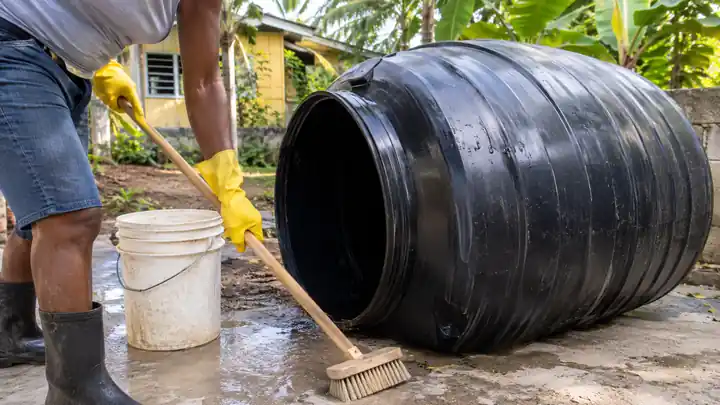
To clean a water tank, scrub from outside with a long-handled brush; the Ministry's only wording, for water containers, is "properly scrubbed with a good cleaning agent and properly rinsed".
What does the Ministry actually say to do?
Who handles this: You, on the ground
Its wording is short: containers should be "properly scrubbed with a good cleaning agent and properly rinsed, with bleach used to sanitize the container." That is from a Ministry notice carried by JIS in August 2004, and it is the only Ministry method we found.
The same notice asks for bleach at "three or five per cent chlorine levels". It gives no brand of cleaner, no steps for a large tank and no measure for an empty one, and we will not invent them. We also found no Jamaican tank maker's cleaning instructions, so follow your own tank's papers where they exist.
Source: Ministry via JIS, Householders urged to purify stored water, 22 Aug 2004
Next: Can someone climb inside to scrub it?Can someone climb inside to scrub it?
Who handles this: You, on the ground
No. Nobody climbs inside a tank, not a child who fits, not a helper who offers. If someone collapses inside one, do not go in; call 110. A closed tank is a confined space, with poor air and the smell of whatever cleaner you just used, and nobody outside can easily lift a person who faints.
The World Health Organization's technical note on tank cleaning points the other way: a brush on a long pole may allow cleaning "without entering it". Our reading is simple. If the opening or the pole will not reach every wall from outside, pay someone with the right equipment instead of sending a person in. The copy we read is on a third-party site, because the WHO link is dead.
Source: WHO, Technical Note 3, third-party copy
Next: How much bleach goes in water already in the tank?How much bleach goes in water already in the tank?
Who handles this: You, on the ground
The only Jamaican whole-tank dose we found is in the 2023 Rainwater Harvesting Planning Guideline: "½ bottle (125 ml)" of plain, unscented, uncoloured 4% bleach to every 1,000 litres (220 gallons) currently in the tank. Then "Wait 24 hours". Wear hand and eye protection.
Dose the water in the tank, not the size printed on it. Our sums:
| Litres now in tank | Bleach |
|---|---|
| 1,000 | 125 ml |
| 2,000 | 250 ml |
| 3,150 | 394 ml |
| 4,546 | 568 ml |
The guideline's figure is for 4%. If your label shows another strength, ask the health department, as we found no official conversion.
Source: Ministry of Economic Growth, bleach dose in guideline, Oct 2023
Next: What about bleach for an empty tank?What about bleach for an empty tank?
Who handles this: Health department
We found no Ministry dose for an empty tank, so ask your parish health department before you mix anything. The Ministry's own website blocked us when we checked, so a newer figure may exist.
You may see a World Health Organization procedure quoted online. It uses granular calcium hypochlorite, which is a different chemical from household bleach, so its figure does not carry across and we do not repeat it.
What we can point to is the 2023 dose above once clean water is back in the tank. Refill, dose by the litres actually in there, and wait the 24 hours.
Source: Stored-water dose, 2023 guideline; WHO, Technical Note 3, third-party copy
Next: How often should a tank be cleaned?How often should a tank be cleaned?
Who handles this: You
Our working figure is every six months, because the 2023 guideline says receptacles should be "kept clean (every six months)". Be aware that the same document gives a much longer interval for tanks elsewhere, and the two do not agree. We go with the shorter one.
Clean sooner if you see sediment, slime or wrigglers, or if floodwater got in: see flooded tanks. If you drink from a rain-fed tank, the guideline also wants the water tested every 6 months; our rainwater safety stack has the detail.
Source: Receptacle clause, 2023 rainwater guideline
Next: Which bleach is the right one?Which bleach is the right one?
Who handles this: You
Plain household bleach, with nothing added. The 2023 guideline specifies "plain household-grade unscented and uncoloured" at 4% active chlorine, so read the label and leave scented, colour-safe and thickened cleaning products on the shelf.
A 2023 Ministry advisory on drought water also said "do not use bulk bleach", which we take to mean bleach of unknown strength sold loose. Measure with something kept for this job, never mix bleach with another cleaner, and store it away from children.
Rinse the tank with clean water only. Containers that held chemicals are out altogether: the Ministry said in 2024 they "should in no way be used".
Source: Bleach clause, 2023 guideline; Drought advisory, Ministry of Health and Wellness, 14 Mar 2023; JIS for the Ministry on containers, 2024
Next: The tank is on the roof. Is this still a home job?The tank is on the roof. Is this still a home job?
Who handles this: Trained, paid person
Probably not, and that is fine. Roof-level jobs are better paid for. Have a trained, paid person do it, on a dry, calm day, and never in rain, wind or under a storm warning. From the ground you can only check what you can see.
Before hiring, ask how they clean without anyone entering, what they will use and where the dirty water goes. We could not confirm any licence for this work, so see hiring a plumber. If this job puts you off your roof for good, compare roof and ground tanks.
Source: General plumbing practice, not a Jamaican document.
Next: How should the day be planned?How should the day be planned?
Who handles this: You
Pick a day when supply is running, not a lock-off, so check the National Water Commission's advisories first.
- Fill clean, covered containers for the day.
- Turn the pump off at the breaker so it cannot run dry.
- Shut your own valve to the tank. Leave the Commission's side of the meter alone.
- Drain off to low level, using it for flushing and domestic jobs, not hosing, while Prohibition Notices apply.
- Keep dirty rinse water out of the cesspool or soakaway if you can; ask the health department if you have nowhere safe for it.
- Refit the lid tightly and check the mesh.
Source: General plumbing practice, not a Jamaican document. NWC advisories, 2 Nov 2026