How a water pump and pressure tank work together
9 cards · about 25 KB · Updated · From Tanks and Taps Jamaica
The answer
A water pump and pressure tank work as a pair: the pump draws from your storage tank, the pressure tank holds water under air pressure, and taps run without the pump starting every time.
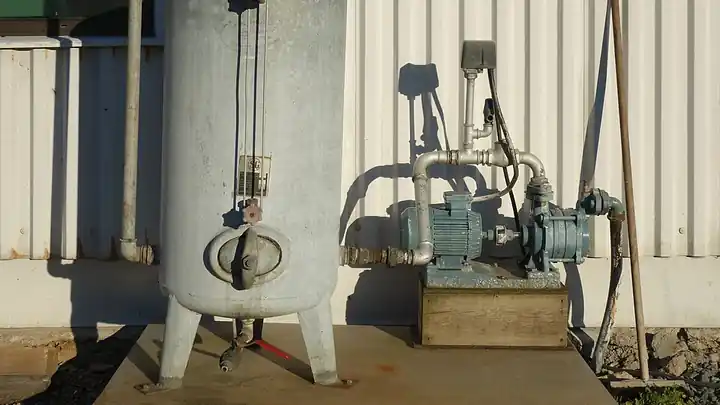
How do the parts fit together?
Who handles this: Plumber
Water runs from the storage tank to the pump, on to the pressure tank, then to the house. A pressure switch sits between them and starts or stops the pump.
Inside the pressure tank, compressed air pushes water out when a tap opens. Small draws, like a hand wash, come from that cushion, so the pump does not start for every cup. When pressure falls far enough the pump starts and refills the cushion.
Without power there is no pump, so you get only what the cushion holds. That is the trade-off of a ground tank against a roof tank. The storage tank still has to be big enough for the lock-offs you get.
Source: General plumbing practice, not a Jamaican document.
Next: What do cut-in and cut-out mean?What do cut-in and cut-out mean?
Who handles this: Plumber
Cut-in is the pressure at which the switch starts the pump, and cut-out is where it stops. A 30-50 switch starts at 30 PSI and stops at 50 PSI. The setting should be on the switch or its paperwork.
One maker's manual (Pentair, for its steel pressure tanks) says to "adjust pre-charge to 2 PSI below pump cut-in pressure setting". Its table:
| Switch setting | Tank precharge |
|---|---|
| 20-40 PSI | 18 PSI |
| 30-50 PSI | 28 PSI |
| 40-60 PSI | 38 PSI |
That is one manual, not a Jamaican rule. We could not obtain the manuals for other pump makers, so check the label on your own tank too.
Source: Pentair, ProSource Plus steel pressure tanks, manual, undated
Next: How is the precharge checked?How is the precharge checked?
Who handles this: You, or a plumber
With the power off and no water in the tank, using a tyre gauge on the air valve. Pentair's line is "Always set pre-charge with NO WATER in tank."
- Switch the pump off at the breaker.
- Open a tap until the flow stops, so the tank has emptied.
- Put the gauge on the air valve, usually under a small cap.
- Compare with the table above. Add or bleed air to match.
- Close the tap, then put the breaker back on.
If water comes out of the air valve, the membrane inside has probably failed, and that is a job for a plumber. Leave the switch cover closed throughout: there is live wiring under it.
Source: Pentair, ProSource Plus steel pressure tanks, manual, undated; General plumbing practice, not a Jamaican document.
Next: Why does my pump keep clicking on and off?Why does my pump keep clicking on and off?
Who handles this: Plumber
Usually because the air cushion is gone, or because water is leaving when it should not. Short bursts wear out a pump and its switch.
Test with every tap shut and nobody using water. If the pump still starts by itself, suspect a running toilet, a leak on the line, or a non-return valve letting water fall back. The meter test on our high bill stack helps separate these.
If it only cycles quickly while a tap is open, check the precharge first. A tank that feels full and heavy, and has no air left, usually needs a plumber. Any new leak on your line costs money as well as pump life.
Source: General plumbing practice, not a Jamaican document.
Next: What if the pump runs dry in a lock-off?What if the pump runs dry in a lock-off?
Who handles this: You
Switch it off at the breaker as soon as you realise the tank is low. A pump that keeps running with no water can damage itself, and it usually gives itself away with a change in sound and no pressure at the taps.
Wait until the storage tank has water again. Some pumps need priming afterwards, so if it runs and moves nothing, call the plumber rather than leaving it on. We could not obtain a pump maker's manual, so we give no safe running time.
If this keeps happening, ask for a low-water cut-off, wired by an electrician. Our lock-off stack covers the rest of a dry day.
Source: General plumbing practice, not a Jamaican document.
Next: Why won't the pump stop?Why won't the pump stop?
Who handles this: Plumber
Because the pressure never reaches the cut-out point, or the switch is failing. Likely causes are a leak or open tap, air getting in on the suction side, a worn pump, or stuck switch contacts.
Turn the breaker off if it has been running a long time, then look for the obvious: a hose left on, a toilet running, water pooling in the yard.
Beyond that, it is a plumber's job for the pump and an electrician's for the switch. Do not tape, jam or wire a switch to force it, and never cap a relief valve or bypass any safety device. Those are what stop a tank or pipe failing under pressure.
Source: General plumbing practice, not a Jamaican document.
Next: Who may touch the wiring?Who may touch the wiring?
Who handles this: Electrician
A licensed or certified electrician, for all of it. Breaker off before you touch anything on or near the pump, and we give no steps for wiring here. The Fire Brigade's Commissioner told JIS in October 2026 that owners of houses 30 to 40 years old should "find a certified electrician".
After a flood, power stays off. The test in JIS's flood tips for switching back on is that "an electrical personnel has confirmed that it is OK", and a pump standing in or near water is no exception. For your storm routine, see before the hurricane.
Source: JIS on old-house wiring, 24 Oct 2026; JIS, Flood Safety Tips, undated
Next: Can a pump go straight on the main?Can a pump go straight on the main?
Who handles this: Plumber
We would not, and part of the official answer is on record. The 2023 Rainwater Harvesting Planning Guideline says pumps "should not be connected to the public water main", and it requires a reflux (non-return) valve. That document is about rain systems, and we found no separate National Water Commission (NWC) rule for every house.
Still, the sensible layout is the same for everyone: NWC fills a storage tank, and the pump draws from that tank, never from the main. If you are thinking of a pump because the supply is weak, read low water pressure first. Ask NWC if you have any doubt about your connection. The rain side is on our rainwater stack.
Source: Ministry of Economic Growth, pump clause in guideline, 2023
A model to compare
Pressure tanks to compare. Listed tanks show the sizes and connections to compare against whatever your plumber proposes.
Plumbing Supply and More has the same owners as this site. It is a US business and shipping to Jamaica is not promised, so treat this as a model to compare, then ask your local supplier for the same type.