Is rainwater safe to drink?
9 cards · about 32 KB · Updated · From Tanks and Taps Jamaica
The answer
Rainwater is safe to drink only after treatment: Jamaica's 2023 guideline asks for a filter plus bleach or boiling, a suitable roof, and a test of the water every six months.
Why not drink it straight from the tank?
Who handles this: You
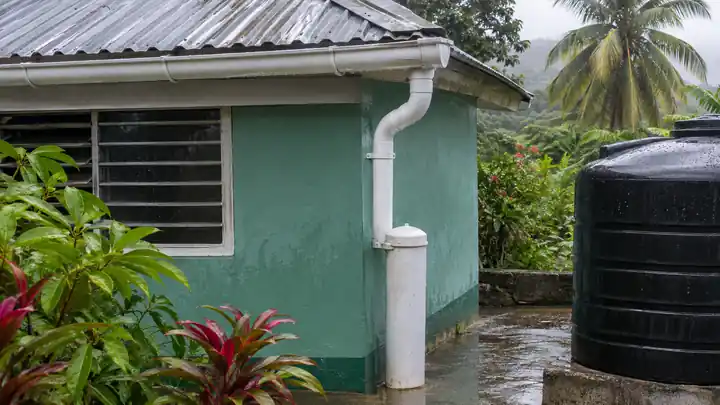
Because clean rain lands on a dirty roof. Bird droppings, dust and leaf litter wash into gutters, and a tank can then hold that mix for weeks. WHO's guidance says "A system to divert the contaminated first flow of rainwater from roof surfaces is necessary", and Jamaica's guideline puts that diversion at 10 gallons (45.5 L) for each rain.
That removes the worst, not all of it. The Ministry's storm advice carries over: water that "looks clean" still "may not be safe". A clear glass tells you nothing about germs. The set-up itself is on our house catchment stack.
Source: WHO drinking-water guidelines, ch. 6; Ministry's post-hurricane note on JIS, Feb 2026
Next: What does the guideline want done before drinking it?What does the guideline want done before drinking it?
Who handles this: You, then installer
Two steps, not one: a filter, plus bleach or boiling. For an indoor drinking tap it names 3-micron sediment and carbon filters.
Treat these as a pair. A filter holds back grit and improves taste, but you should not count on it to kill germs, which is the job of the bleach or the boil. Filters also clog and need changing on the maker's schedule, so a neglected one is a weak point. If you only drink from one tap, one filtered line to that tap is cheaper to look after than treating the whole house. Compare these only after you have settled the disinfecting step.
Source: Planning guideline on rainwater, 2023; general practice on what filters do
Next: How much bleach goes in the tank?A model to compare
Filters and housings to compare. Sediment and carbon cartridges in standard housings are the parts the guideline's indoor set-up calls for, so this range shows what to compare.
Plumbing Supply and More has the same owners as this site. It is a US business and shipping to Jamaica is not promised, so treat this as a model to compare, then ask your local supplier for the same type.
A model to compare
A whole-house carbon filter. This is one whole-house carbon model to compare if you want carbon on every tap, and it does not replace the bleach or boiling step.
SoftPro Water Systems has the same owners as this site. It is a US business and shipping to Jamaica is not promised, so treat this as a model to compare, then ask your local supplier for the same type.
How much bleach goes in the tank?
Who handles this: Ground level or trained
The guideline's dose is "½ bottle (125 ml)" of plain, unscented, uncoloured household bleach with 4% active chlorine, for every 1,000 L (220 imperial gallons) now in the tank. Then wait 24 hours, wearing hand and eye protection.
| Water in tank | Bleach, our sum |
|---|---|
| 1,000 L | 125 ml |
| 2,000 L | 250 ml |
| 3,150 L | about 394 ml |
Measure how full the tank is, not its size. Check the strength on your bottle, since this dose assumes 4%. A tank up high is a job for someone trained, and nobody climbs in. More on tank cleaning.
Source: Planning guideline on rainwater, 2023
Next: What about treating just a jug at a time?What about treating just a jug at a time?
Who handles this: You
The simplest route for a small household. The Ministry's Feb 2026 advice, written for storms, is to boil "for at least one minute", or use "two drops of household bleach (use a dropper to measure)" per litre, stir and leave for 30 minutes.
Older notices said three or five minutes of boiling. One minute is the latest we found; follow any newer notice. Keep treated water in a clean, covered container and pour rather than dip. Never reuse a chemical container. The Ministry's larger doses are on our drinking water after a storm stack.
Source: Ministry's post-hurricane note on JIS, Feb 2026; Ministry dose note on JIS, Jul 2024; Ministry drought advisory, archived, Mar 2023
Next: Which roofs are wrong for drinking water?Which roofs are wrong for drinking water?
Who handles this: You
Asphalt types: the guideline places them on the non-potable side. It accepts metal including zinc, wood shakes, concrete and clay for drinking water. WHO adds that bitumen-based coatings are "generally not recommended", and says to avoid lead paint.
So the question is often less the sheet than what was put on it. Ask what the coating or sealant was and whether it was meant for a drinking-water roof. If nobody can say, keep that roof's water for flushing and washing until you get an answer. No filter or dose on this page is offered as a cure for a bad coating.
Source: Planning guideline on rainwater, 2023; WHO drinking-water guidelines, ch. 6
Next: How can anyone tell it is working?How can anyone tell it is working?
Who handles this: Health department
Test it. The guideline says potable rainwater should be tested every 6 months. It doesn't name a laboratory in what we read, and the documents we read give no list of them, so ask your parish health department where to send a sample and what to test for.
The guideline also gives chlorine residual figures that don't agree with each other, so we are not repeating them. Don't try to work out a target for your tank from it; ask the health department instead. Write down test dates, bleach dates and filter changes on a card by the tank, which helps the next inspection too.
Source: Planning guideline on rainwater, 2023
Next: Does a mosquito problem or a flood change the answer?Does a mosquito problem or a flood change the answer?
Who handles this: You, then health department
Both do. Wrigglers mean the tank is open to the air, so fix that before anything else. The Ministry's line is "Cover tightly", and WHO asks for fitted covers with "mosquito-proof mesh" on openings. See mosquitoes in the tank.
If floodwater got in, stop drinking it. The Ministry's words on floodwater are "Use it only for flushing toilets." No Jamaican procedure turned up for bringing a flooded tank back into use, so ask the parish health department, and read flooded tanks and septics first.
Source: Ministry post-storm advisory on JIS, Jul 2021; WHO drinking-water guidelines, ch. 6; Ministry's post-hurricane note on JIS, Feb 2026
Next: Can it go untreated to toilets and washing?Can it go untreated to toilets and washing?
Who handles this: Plumber
For indoor non-drinking use the guideline still asks for something: a filter rated at 5 microns, plus pipe in purple or some other set colour, so the line can't be mistaken for drinking water.
That split is worth having, because most household water never reaches anyone's mouth. Keep drinking and cooking on the treated tap, and let toilets take the rest. Label any outside tap fed from the tank so a child or visitor doesn't drink from it. If you also have a mains supply, the two systems must stay apart, as our catchment stack explains.