Mosquitoes breeding in your water tank
9 cards · about 46 KB · Updated · From Tanks and Taps Jamaica
The answer
Mosquitoes in your water tank in Jamaica mean there is a gap: fit a tight cover, put mosquito-proof mesh on every opening, and let vector control teams check the yard.
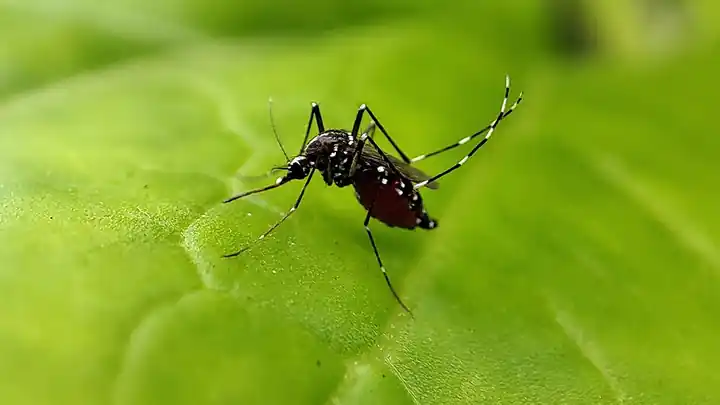
Why do tanks and drums attract them?
Who handles this: You
Because the mosquito behind dengue, Aedes aegypti, breeds "in anything that can hold water", as a 2023 JIS report on the vector control teams put it. Clean stored water suits it well, so a tidy-looking tank can still be the source.
Storing water through lock-offs makes this worse. The Observer quoted Minister Tufton in October 2025 saying storage can "unintentionally create breeding sites". The Gleaner reported in 2015 that the "45-55 gallon drum is the main breeding habitat", which is old but still worth checking in your own yard. The answer is to keep storing, and to close the way in.
Source: JIS, Vector control teams, 26 Sep 2023; Jamaica Observer, 15 Oct 2025; Gleaner, Drum covers, 12 Jun 2015
Next: What does the Ministry tell householders to do?What does the Ministry tell householders to do?
Who handles this: You
Cover it. The Ministry of Health and Wellness says: "Cover tightly all drums, barrels, tanks, and buckets that are storing water for use."
The World Health Organization goes one step further for tanks: "Covers should be fitted, and openings need to be protected by mosquito-proof mesh." A lid sitting loose is not fitted, and a mosquito needs very little room.
Look at the lid seat, the thread and any split in the plastic. Replace a lid that no longer closes properly rather than weighting it with a block. We found no Ministry mesh size for tanks, so put that question to your parish health department.
Source: Ministry of Health and Wellness via JIS, 5 Jul 2021; WHO, Guidelines for drinking-water quality, ch. 6
Next: Where else can they get in?Where else can they get in?
Who handles this: You, on the ground
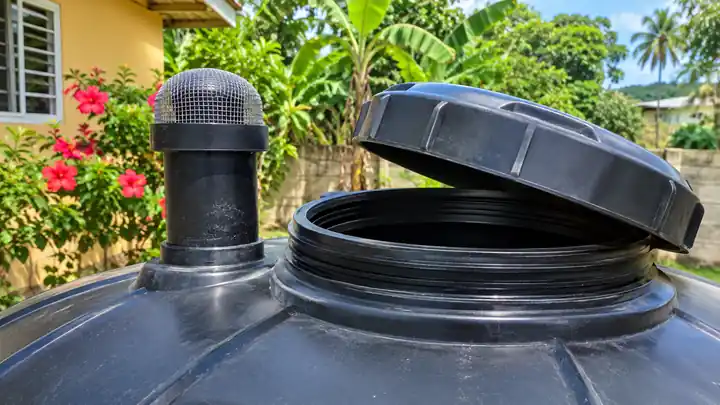
Through the overflow, the vent and any inlet that is not sealed. These are the openings people forget, because the lid looks shut.
- Overflow pipe: mesh over the outer end, held with a clamp.
- Vent: a mesh cap.
- Inlet from a gutter: a sealed joint, not a gap around the pipe.
Keep the mesh clear, because a blocked overflow will back up. On a rain system, a leaf screen is not enough: the 2023 guideline allows openings up to 1.27 cm (0.5 in), which stops leaves, not insects. See rainwater harvesting. Check roof tanks from the ground, or pay someone trained on a dry, calm day.
Source: Growth and Job Creation Ministry, leaf screen clause, 2023; General plumbing practice, not a Jamaican document.
Next: What about open drums and barrels?What about open drums and barrels?
Who handles this: You
Give every drum a real cover. The Gleaner reported in 2015 that the Ministry had developed a drum cover "made of mosquito netting" that "resembles a large hair net". We could not confirm whether these are still handed out, so ask at the parish health department.
A fitted lid with a tap low on the drum beats netting, because nobody has to open it. Where you do draw from the top, the Ministry's line is "Pour water instead of dipping into containers", which also keeps dirty cups out. Drums used during a lock-off should be emptied and scrubbed when you no longer need them, not left half full.
Source: Gleaner, Drum covers, 12 Jun 2015; JIS, Ministry hurricane water notice, Feb 2026
Next: Is it true you can pour cooking oil on the water?Is it true you can pour cooking oil on the water?
Who handles this: You
It is what the Ministry has said, for containers that cannot be covered: "If container cannot be covered, pour cooking oil to cover the surface of the water."
We would not do that to water you plan to drink. For a tank feeding your pipes, a cover is the fix, because oil can coat the walls and reach the taps. That second part is our own view, not the Ministry's.
Other products are a question for the health department. We found no larvicide product or dose published for householders, so do not improvise with kerosene, pesticides or anything from the farm store.
Source: Ministry of Health and Wellness via JIS, 5 Jul 2021
Next: Wrigglers are already in the tank. What now?Wrigglers are already in the tank. What now?
Who handles this: You, on the ground
Stop drinking that water untreated, close the gap, and then clean. We found no Ministry instruction written for wrigglers already in a tank, so this is ordinary good sense more than an official procedure.
Find the way in first, otherwise you will have them back. Then follow cleaning a tank, from outside, with nobody climbing in. Until then, treat drinking water as our drinking water stack sets out.
The 2023 bleach dose is written to disinfect stored water. Nothing we read says it clears mosquito larvae, so do not count on it for that. If the problem keeps coming back, ask the parish health department to look.
Source: Bleach dose wording, 2023 guideline; General plumbing practice, not a Jamaican document.
Next: What do the vector control teams actually do?What do the vector control teams actually do?
Who handles this: Health department
They find and destroy breeding sites, treat water and fog. The 2023 JIS report said teams identify and eliminate sites, were fogging "seven days per week", and had "intensified our larvicidal activities", and it asked householders to give them access. The Observer reported in October 2025 "approximately 492 permanent vector control workers".
So let them into the yard, and show them the tank, drums and anywhere else you worry about. Those statements are dated, and coverage in your district may differ, so ask your parish health department what is running now and how to request a visit.
Source: JIS, Vector control teams, 26 Sep 2023; Jamaica Observer, 15 Oct 2025
Next: What else in the yard needs checking?What else in the yard needs checking?
Who handles this: You
Everything that can hold a capful of water after rain. The Office of Disaster Preparedness and Emergency Management asks people to punch holes in containers "in which water can settle".
That covers paint buckets, old basins and anything you are not using to store water. Do not punch what you need for storm supplies. Tip out plant saucers and old tyres. The World Health Organization's rainwater advice also says to clean gutters, since a sagging one holds a pool: book that as paid work if the gutter is at roof height. Go round again after any flood, and see flooded tanks.
Source: ODPEM, Floods, undated; WHO, Guidelines for drinking-water quality, ch. 6