Water locked off: what to do now
10 cards · about 48 KB · Updated · From Tanks and Taps Jamaica
The answer
For a water lock off, what to do first: check the National Water Commission's advisories page, close every tap, and ration your stored water until supply returns.
Where is the lock-off schedule posted?
Who handles this: You
Check the advisories page of the National Water Commission (NWC), which lists current and planned disruptions by parish. If your area is not there, ask two neighbours whether they are dry too. That separates a street problem from a house problem.
Schedules can follow falling reservoir levels, so the reservoir page is the early warning for the Corporate Area. On 2 Nov 2026 it showed Mona at 43.4% and Hermitage at 57%; our Kingston and St Andrew stack has more.
Outside town, a dry tap after a downpour may be a blocked river intake rather than drought. Some districts get water from a parish council or private licensed provider instead, as our rural parishes stack explains.
Source: NWC notices by parish, 2 Nov 2026; NWC, Reservoir levels, 2 Nov 2026; NWC FAQs on wells and intakes, 2 Nov 2026
Next: What comes first when the taps go dry?What comes first when the taps go dry?
Who handles this: You
Close every tap, then find out what you have in store.
- Shut all taps, inside and in the yard, including any you opened to test.
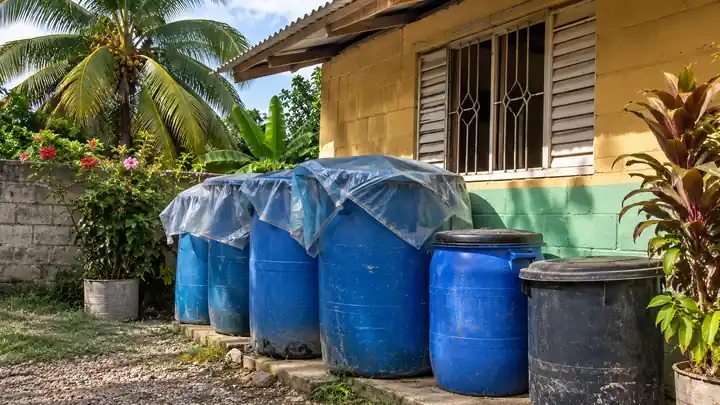
- Look in the tank or drums and estimate how full they are.
- Draw off drinking and cooking water into clean, covered containers and set them apart.
- If a pump feeds the house and the tank is nearly empty, switch it off at the breaker before it runs dry. Our pump stack explains why.
- Tell the household: laundry and long showers wait until you know how long this lasts.
Source: General plumbing practice, not a Jamaican document.
Next: Why not leave a tap open to catch the water's return?Why not leave a tap open to catch the water's return?
Who handles this: You
Because supply often returns when nobody is watching, and that open tap then runs across the floor and through your meter. NWC's domestic water rate starts at J$162.14 per 1,000 litres and climbs by band to J$536.54 over 41,000 litres (effective May 6 2026), with sewerage charged on top where it applies.
Try the outside tap briefly, morning and evening, then close it again. You can also look at the meter dial: if it moves with everything shut, water is back and something is using it. If a bill jumps after a lock-off, go through our high bill checks.
Source: NWC, Rates and Tariff, effective May 6 2026
Next: How can stored water be made to last?How can stored water be made to last?
Who handles this: You
Rank the uses: drinking and cooking first, then hands and food, then everything else. The World Health Organization puts hydration alone at 5.3 litres a person a day, and says 20 litres is often enough for drinking, cooking, food hygiene and washing hands and face, but not other hygiene. For four people that is 80 litres a day, our sum.
Bathe from a bucket, wash dishes in a basin, and keep the rinse water for the toilet. Keep every container covered so you are not raising mosquitoes. If you run out every time, your tank may be too small.
Source: WHO report on water quantity, 2020
Next: How do you flush a toilet with stored water?How do you flush a toilet with stored water?
Who handles this: You
Pour a bucket straight into the bowl, quickly and in one go, and the bowl will clear without the cistern. Filling the cistern just locks up water you may want later.
Use bath water, rinse water or anything else you would not drink, and flush less often while the lock-off lasts. Keep a separate bucket for this job, because the Ministry of Health and Wellness wants clean stores poured, in its words "instead of dipping into containers".
If the only spare water is floodwater, the Ministry's line is "Use it only for flushing toilets." We found no Jamaican figure for how much a bucket flush takes.
Source: Health Ministry via JIS, post-hurricane water, 26 Feb 2026; General plumbing practice, not a Jamaican document.
Next: Is water that has sat in a drum safe to drink?Is water that has sat in a drum safe to drink?
Who handles this: You
Not automatically. The Ministry's February 2026 notice warns that clear water still "may not be safe".
If you have any doubt, boil it "for at least one minute", or use the measured bleach drops set out in our drinking water stack. One minute is the latest boil time; older notices said three or five, and any newer notice beats all of them.
Never store drinking water in a drum that once held chemicals: the Ministry said in 2024 that such containers "should in no way be used". Scrub and rinse the rest between fills, as our tank cleaning stack sets out.
Source: Health Ministry notice on JIS, Feb 2026; Ministry storm water notice on JIS, Jul 2024
Next: The water is back but brown or spitting. What now?The water is back but brown or spitting. What now?
Who handles this: You
Run a cold tap low in the house, nearest the meter, into a bucket until it clears. NWC's FAQ expects discoloured water to clear with running, and wants to hear from you if it does not. Its explanation for cloudy cold water is air or calcium carbonate, "perfectly safe" either way.
Spitting and coughing is air. Open taps one at a time, lowest first, until each runs smooth, then close them.
Save the brown bucket for flushing. After Hurricane Melissa a Westmoreland health officer said of discoloured NWC water, "avoid consuming it until it's safe". Switch the pump back on only once the tank has water in it.
Source: NWC FAQs on discoloured water, 2 Nov 2026; Westmoreland health officer on JIS, Nov 2025
Next: What is a hose banned for right now?What is a hose banned for right now?
Who handles this: You
The Gleaner reported on 11 Aug 2026 that Prohibition Notices cover St Catherine, St Ann, Portland, St Mary, St Thomas, St Andrew and Kingston "until further notice", enforced from August 17. It listed as banned:
- watering gardens, lawns, grounds and farms
- filling ponds or pools
- "Washing of vehicles with the use of a hose"
- washing roadways, pavements, paths and garages
Ordinary domestic use is outside the ban. A mid-October Gleaner report said the restrictions "remain in effect". Check the advisories page for today's position. A 2023 notice made a breach an offence, with a fine and, in default, up to 30 days' imprisonment.
Source: Gleaner, Water lockdown, 11 Aug 2026; Gleaner, 14 Oct 2026; JIS, NWC measures, 29 May 2023
Next: My street has water and my house doesn't. What then?My street has water and my house doesn't. What then?
Who handles this: NWC
Check your own side first: your gate valve, the tank's float valve, and whether the meter has been locked. Stay off NWC's side of the meter, and never turn a street valve.
If it was locked for arrears, NWC's Guaranteed Standards promise supply within 24 hours of paying (WGS11), and its rate page shows a J$1,000 reconnection fee for a locked domestic meter. A wrongful disconnection should be reconnected within 8 hours (WGS12).
For anything else, write to them. Standard WGS4 gives NWC 5 working days to acknowledge and 30 to investigate or report back. If a trickle does arrive, see low pressure.
Source: NWC, Guaranteed Standards, read 2 Nov 2026; NWC fee list on the rate page, 2026