Making drinking water safe after a storm
9 cards · about 32 KB · Updated · From Tanks and Taps Jamaica
The answer
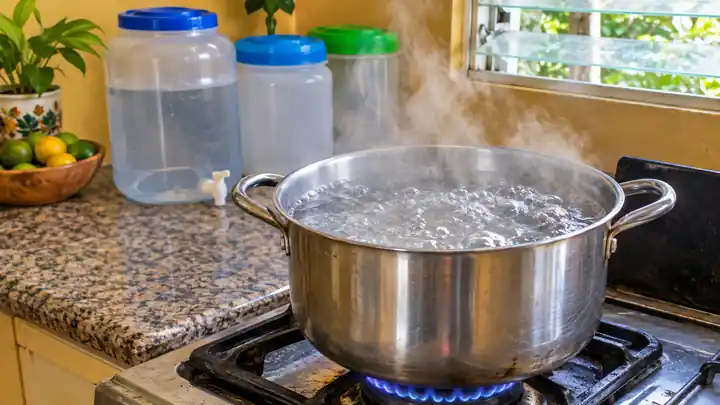
Drinking water after a hurricane in Jamaica should be boiled for at least one minute, or treated with two drops of household bleach per litre and left for 30 minutes, the Ministry said in February 2026.
What is the exact advice?
Who handles this: You
Here it is word for word, from the Ministry of Health and Wellness, published on JIS, 26 February 2026:
"Boil water for at least one minute before use."
"If boiling is not possible, add two drops of household bleach (use a dropper to measure) to one litre of water, stir, and let it sit for 30 minutes before consuming."
The notice adds that water which looks clean may still be unsafe. So clear water from a pipe, tank or spring gets the same treatment until officials say otherwise. Use treated water for brushing teeth and mixing feeds too.
Source: Ministry notice on JIS, Feb 2026; teeth and feeds are general practice.
Next: How much bleach for a bucket or a drum?How much bleach for a bucket or a drum?
Who handles this: You
The Ministry gave larger amounts in July 2024. Measure carefully, and do not guess.
| Water | Bleach | Wait |
|---|---|---|
| 1 litre | 2 drops | 30 minutes |
| 20 litres (five gallons) | half teaspoon | 30 minutes |
| 170 litres (45 gallons) | 4 ½ teaspoons | 30 minutes |
The gallons here are US gallons. Mix well before the wait. A 2004 Ministry notice called for bleach "with three or five per cent chlorine levels", and a 2023 advisory said "do not use bulk bleach". Check the label for strength, and avoid scented bottles.
Source: Ministry on JIS, 3 July 2024; Ministry on JIS, August 2004; Ministry drought advisory, March 2023 (archived)
Next: Why do other notices say to boil for longer?Why do other notices say to boil for longer?
Who handles this: You
Because the advice has changed over the years. The latest is one minute. Older notices said three or five: the Ministry's March 2023 advisory asked for a "rolling boil" kept up "for three minutes", and a July 2021 notice said "at least five minutes".
The one-minute wording appears in 2024, November 2025 and February 2026 notices, so we use it here. If the Ministry or your parish health department puts out anything newer, follow that instead of this page.
Source: Notice of 26 Feb 2026; Advisory of March 2023; Ministry storm advisory, July 2021
Next: Can floodwater be treated and drunk?Can floodwater be treated and drunk?
Who handles this: You
No. The same Ministry notice says of floodwater: "Use it only for flushing toilets." Boiling and two drops are for water you have a reason to trust, not for water that has run over yards, pits and roads.
Keep this in mind for a tank or drum the flood reached. If the water got in, it is floodwater now, however clear it looks after settling. We found no Jamaican procedure for bringing such a tank back into use, and the steps we could confirm are on flooded tank and septic.
Do not wash vegetables, dishes or hands in it, and keep children from playing in it.
Source: Ministry floodwater line, Feb 2026
Next: Is NWC water safe once it comes back?Is NWC water safe once it comes back?
Who handles this: Health department
Not automatically. We could not find a National Water Commission (NWC) boil-water notice, so do not wait for one. After Hurricane Melissa, a November 2025 notice said "high turbidity, infrastructure damage, and prolonged power outages have disrupted" treatment, and urged citizens to treat water.
A Westmoreland health officer warned that NWC water which is "discoloured or has high turbidity" should not be consumed "until it's safe".
Recovery can take months. The Gleaner reported on 27 November 2025 that "65% indicate satisfactory levels of chlorination". PAHO was still describing inadequate levels in a regional report in January 2026.
Source: JIS on treatment, Nov 2025; JIS, Westmoreland, Nov 2025; Gleaner, 27 Nov 2025; PAHO regional situation report, Jan 2026
Next: What containers are safe?What containers are safe?
Who handles this: You
Clean ones that have never held chemicals. Containers that have "should in no way be used", per the Ministry in 2024. The Ministry's 2004 wording is "properly scrubbed with a good cleaning agent", rinsed, and "bleach used to sanitize the container", with no measure given.
For small containers only, US guidance from the CDC gives a measure: "1 teaspoon of unscented liquid household chlorine bleach in 1 quart (4 cups) of water", shaken, left "at least 30 seconds", poured out and air-dried. Whole tanks are different; see cleaning a water tank.
The Ministry also says "Pour water instead of dipping into containers."
Source: 2024 notice; 2004 notice; CDC, emergency water supply, 27 Jun 2025; 2026 notice
Next: What about tank water, rainwater or a well?What about tank water, rainwater or a well?
Who handles this: Health department
Treat all of it as suspect until you know more. Stored tank water that the flood did not reach can be treated by the cup or bucket using the doses above. The 2023 guideline's dose for a whole tank is on cleaning a water tank, and our notes on whether rainwater is safe to drink cover catchment.
Wells are harder, because you cannot see what got in. US EPA guidance says to leave well water undrunk until it has been tested. That is US advice, and no Jamaican procedure turned up. Your parish health department can advise; see also wells and springs.
Source: EPA, after-flood septic advice, 2005
Next: When can we stop treating the water?When can we stop treating the water?
Who handles this: Health department
When officials say so. The Ministry's wording is to treat "until officials confirm that the supply is safe". ODPEM puts it as "Boil all drinking water until you are sure that a safe water supply has been restored", and asks people to keep stored water until then.
Do not take a neighbour's word, or clear water from the tap, as the all-clear. After Melissa made landfall on 28 October 2025, PAHO's regional report of 27 January 2026, three months on, still described chlorine and bacteria levels as not yet adequate for domestic systems. It is a regional summary, so it does not tell you about your parish.
Ask your parish health department, and check NWC's advisories by parish. Prepare early by reading before a hurricane.
Source: The Feb 2026 notice; ODPEM tips as printed by JIS; OPM on Melissa, Nov 2025; NWC, advisories