Is the water hard where you live in Jamaica?
10 cards · about 18 KB · Updated · From Tanks and Taps Jamaica
The answer
Hard water in Jamaica is likely wherever limestone feeds the supply, but we found no parish or National Water Commission table, so test your own tap.
Is there a hardness table for my parish?
Who handles this: You
No, not one we could find. We looked for hardness figures by parish and by National Water Commission (NWC) system and came up empty, so this site publishes no parish table.
The Water Resources Authority's 2022 master plan refers to a 2018 water quality atlas, which we could not obtain. The Authority also runs a web map, but we took no hardness reading from it.
Be wary of any chart that ranks Jamaican parishes by hardness without naming where the numbers came from. You can also ask NWC about your system; we cannot say whether it will have a figure to give you.
Source: WRA, National Water Resources Master Plan, 2022; WRA, web map
Next: How hard does water have to be before it counts as hard?How hard does water have to be before it counts as hard?
Who handles this: You
On the US Geological Survey scale, anything from 121 mg/L counts as hard. That is a US scale. We found no Jamaican scale for tap water, so treat this as a yardstick and nothing more.
| mg/L as calcium carbonate | US label |
|---|---|
| 0 to 60 | Soft |
| 61 to 120 | Moderately hard |
| 121 to 180 | Hard |
| More than 180 | Very hard |
If your test kit reads in other units, use the conversion printed in its leaflet rather than guessing.
Source: USGS, Hardness of water
Next: Why would water here be hard at all?Why would water here be hard at all?
Who handles this: You
Rock is the reason. Limestone aquifers sit under about half of Jamaica's land area, against about 6% for alluvium, and water passing through limestone picks up calcium carbonate.
NWC also says wells account for more than 60% of what it supplies each day. Put those two facts together and a well-fed supply in limestone country is a fair suspect.
A suspect is not a measurement, though. Your tap may run from a river intake, a rain tank or a well of your own, and each can test differently. Rainwater, having never touched the rock, usually starts out soft.
Source: WRA, Master Plan 2022, p.38; NWC, FAQs; the note on rainwater is general plumbing practice.
Next: What Jamaican numbers do exist?What Jamaican numbers do exist?
Who handles this: You
A few, and none of them describes your tap. WRA's master plan gives a national guideline range of 127.0 to 381.0 mg/L as calcium carbonate. NEPA's draft freshwater standard of 2009 shows the same range, for rivers and streams.
The only field readings we found date from 1970: St Ann rivers on White Limestone at 155 to 188 ppm by site, mean 173, and a spring near Dromilly, St James, at 172 ppm.
Set against the US scale, those old readings land in hard or very hard. Our reading, on old river data.
- St Ann rivers, lowest site155 ppm
- Spring near Dromilly, St James172 ppm
- St Ann rivers, mean173 ppm
- St Ann rivers, highest site188 ppm
Source: WRA, Master Plan 2022, p.60; NEPA, Draft Ambient Freshwater Standard, 2009; J. Geol. Soc. Jamaica XI, 1970
Next: My cold water comes out cloudy, or leaves white crust. Is that safe?My cold water comes out cloudy, or leaves white crust. Is that safe?
Who handles this: You
Cloudy cold water is usually harmless. NWC says it can be air or calcium carbonate and calls it "perfectly safe".
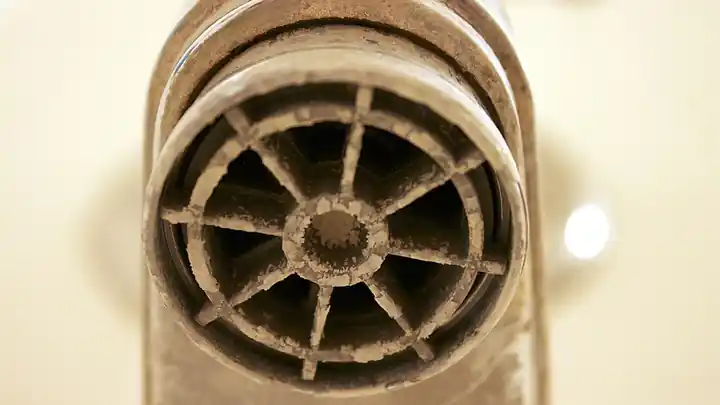
A quick check: fill a clear glass and leave it on the counter. Air clears from the bottom up within moments. Mineral haze takes longer and may leave fine white sediment. White crust around taps and shower heads is the same mineral, dried out.
Brown, yellow or black water is another matter. In NWC's account, colour tends to go once the tap has run a while; if it lingers, tell them. For the dark water some Portmore homes get, see our St Catherine notes.
Source: NWC, FAQs; glass check is general plumbing practice.
Next: What does scale actually do to my house?What does scale actually do to my house?
Who handles this: You, then a plumber
Mostly it costs money slowly. USGS says scale "can reduce the life of equipment, raise the costs of heating the water". One maker's manual, Rheem New Zealand, notes that calcium carbonate deposits on any hot metallic surface, so anything that heats water takes the worst of it.
- A solar water heater or storage heater collects it inside.
- An electric shower head can choke. Breaker off before you touch it, and any opening up or wiring goes to a licensed electrician.
- Aerators narrow, which feels like low pressure at one tap.
Unscrew a tap aerator and soak it in white vinegar before you pay for anything bigger.
Source: USGS, Hardness of water; Rheem NZ, solar manual, 2014; the vinegar soak is general plumbing practice.
Next: How can you test your own water?How can you test your own water?
Who handles this: You
Use a hardness test kit or strips, and test each source separately. Your NWC line, your tank and any well can all read differently, and a tank that takes both rain and piped water will shift as the mix changes.
Take the sample from a cold tap after it has run for a short while. Write down the date, the source and the reading, then repeat after a long dry spell and again after heavy rain. Two or three readings tell you far more than one.
Nothing here tests for germs. Hardness says nothing about whether water is safe to drink.
Source: General plumbing practice, not a Jamaican document.
Next: Is a water softener worth buying?A model to compare
Hardness, iron and pH test kit. A field kit to compare if you want real numbers for your tap before spending on any treatment.
Quality Water Treatment has the same owners as this site. It is a US business and shipping to Jamaica is not promised, so treat this as a model to compare, then ask your local supplier for the same type.
Is a water softener worth buying?
Who handles this: Plumber
Only if your test reads high and scale is costing you. Vinegar and the odd new aerator may be enough.
A softener swaps hardness minerals for sodium and needs salt, a drain line and room to sit on the house side of your pump and pressure tank. Before buying, settle three things:
- Where the waste brine goes. We found no Jamaican rule on sending it to an absorption pit, so ask your parish health department.
- Whether you keep one tap unsoftened for drinking, a common choice.
- Whether a lock-off or an empty tank would leave it running dry.
Source: General plumbing practice, not a Jamaican document.
Next: Are salt-free conditioners or magnets worth buying?A model to compare
A softener model to compare. Useful for comparing size, salt use and drain needs once a test shows you really have a scale problem.
SoftPro Water Systems has the same owners as this site. It is a US business and shipping to Jamaica is not promised, so treat this as a model to compare, then ask your local supplier for the same type.
Are salt-free conditioners or magnets worth buying?
Who handles this: You
Be sceptical, and ask for evidence first. A salt-free unit does not take calcium out of the water, so a hardness test afterwards will read about the same. Whatever it claims to do, it claims to do to how scale forms.
We found no Jamaican standard or test covering these units. Ask the seller three questions: what was tested, by whom, and on water how hard? No written answer, no sale.
Cheaper first steps: clean aerators and keep the heater no hotter than you need. Green or flaking outdoor fittings are a different problem with a different cause; see salt air.
Source: General plumbing practice, not a Jamaican document.