You smell gas from the LPG cylinder. What now?
9 cards · about 33 KB · Updated · From Tanks and Taps Jamaica
The answer
Gas smell from an LPG cylinder means get everyone out first, touch no switches, use no phone inside, and call 110 from outside, away from the house.
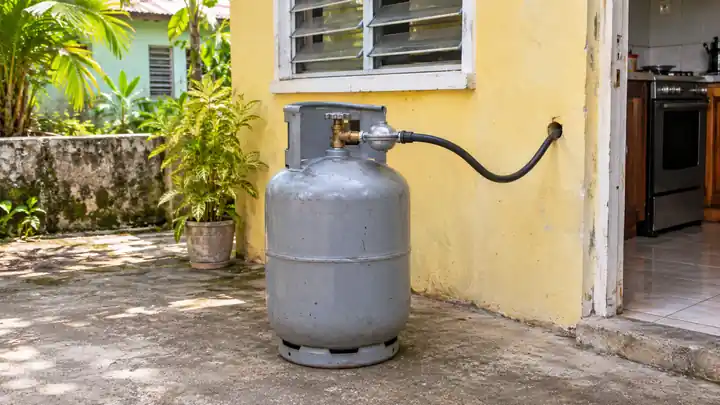
What do you do, in what order?
Who handles this: You, on the ground
Do these in this order:
- Tell everyone to leave now, and help children and older people out
- Touch no light switch, fan, stove knob or plug on the way
- No phone calls, lighters, candles or cigarettes inside
- Once outside and away from the house, call 110 for the Fire Brigade
- Give the community, parish, nearest town and a callback number, as the Brigade asks
- Warn the neighbours, and stay out
If your phone is not already on you, do not stop to find it. Use a neighbour's phone. Getting out first is our cautious rule, and the next cards explain where it comes from.
Source: Jamaica Fire Brigade site; Brigade via JIS, August 2021; leaving first is a cautious general rule, not a Brigade quote.
Next: Why does a light switch matter?Why does a light switch matter?
Who handles this: You, on the ground
A small spark can be enough to set off gas that has built up in a room. A Jamaica Fire Brigade superintendent put it this way in December 2024: "never ever turn on a light... a spark goes [off] in the switch".
The same reasoning is why we extend it to fans, plugs, doorbells and anything else electrical. The Brigade's talk does not mention phones or calling from outside. Those are our own caution, because the call can wait the few seconds it takes to get out.
LPG is heavier than air and can settle low in a room, so a weak smell at head height tells you little about the air near the floor.
Source: JFB via JIS, 24 Dec 2024; the phone rule and LPG behaviour are general safety practice.
Next: Does the Fire Brigade say the same thing?Does the Fire Brigade say the same thing?
Who handles this: Fire Brigade
Not quite, and you should know the difference if you read its page. The December 2024 JIS report of the Brigade's advice carries the spark warning and tells people to call the Brigade. But that talk goes on to checking the stove and cylinder and airing the house; this site puts getting out first and leaves those checks to the Brigade or your gas supplier.
Our reasoning is simple. Someone standing outside is not near any spark, and a crew can do those checks with training and equipment. We found no other Jamaican household gas guidance to weigh this against, so if the Brigade issues newer advice, read it.
Source: JFB via JIS, 24 Dec 2024
Next: Is it safe to go back in once the smell fades?Is it safe to go back in once the smell fades?
Who handles this: Fire Brigade
No. A fading smell outside does not tell you the rooms are clear, and it certainly does not tell you the leak has stopped. Stay out until the Brigade or your gas supplier says the house is safe.
That holds for the things people tend to go back for: documents, a phone, a pot left on the stove, or a pet that has not come out. Tell the crew when they arrive if a person or animal may still be inside, and which room you think the smell was strongest in.
If the crew is delayed, call 110 again from outside and keep waiting there.
Source: General safety practice, not a Jamaican document.
Next: Who deals with the hose, regulator or cylinder?Who deals with the hose, regulator or cylinder?
Who handles this: Gas supplier
Your gas supplier or a qualified gas person, not you. Do not tighten, swap or test a hose, regulator or valve yourself, and do not move a cylinder that you think is leaking.
We could not give you replacement intervals or fitting rules, because we found no household LPG guidance from Petrojam or the Bureau of Standards, and no Brigade rules on hoses or regulators.
Source: General safety practice, not a Jamaican document.
Next: Where should a cylinder be kept?Where should a cylinder be kept?
Who handles this: Gas supplier
We found only one Jamaican line, and it comes from a bushfire chapter. ODPEM's booklet says "gas cylinders should be kept upright with their relief valve away from the building". It is not general storage advice, so do not take it as a full rule.
We found no Jamaican rule on indoor or outdoor storage, or on spacing, so ask your supplier where it should sit in your house. Never cap, plug or block a relief valve on a cylinder.
Source: ODPEM disaster booklet, 2019 upload
Next: What about gas after a storm or a long outage?What about gas after a storm or a long outage?
Who handles this: Gas supplier
ODPEM is direct: "If gas is turned off for any reason, only a qualified professional can turn it back on." That goes for storm damage, flooding and any outage where the supply has been shut.
ODPEM's wording on when to shut utilities before a storm is on our hurricane list, and flood damage sets out what comes after.
If you smell gas when you come home after a storm, do not go in. Use the same order as the first card: everyone out or kept out, no switches, 110 from outside.
Source: ODPEM disaster booklet, 2019 upload
Next: It smells like rotten eggs. Could it be the pit instead?It smells like rotten eggs. Could it be the pit instead?
Who handles this: You, on the ground
It could, but do not stand there deciding. LPG is usually given a strong added smell so leaks get noticed, and sewer gas has a "strong odor of rotten eggs", as NIOSH describes hydrogen sulfide. By nose alone, you cannot reliably tell them apart.
So if the smell is indoors and you cannot explain it, treat it as gas: out first, then 110 from outside. Tell the crew about the pit as well. If it turns out to be drains, that is a separate job, and signs of a full cesspool picks it up from there. Nobody should open a pit cover to compare smells.
Source: NIOSH, hydrogen sulfide; the added LPG smell is general safety knowledge.